

China Leads Growth While the U.S. and EU Continue to Decline
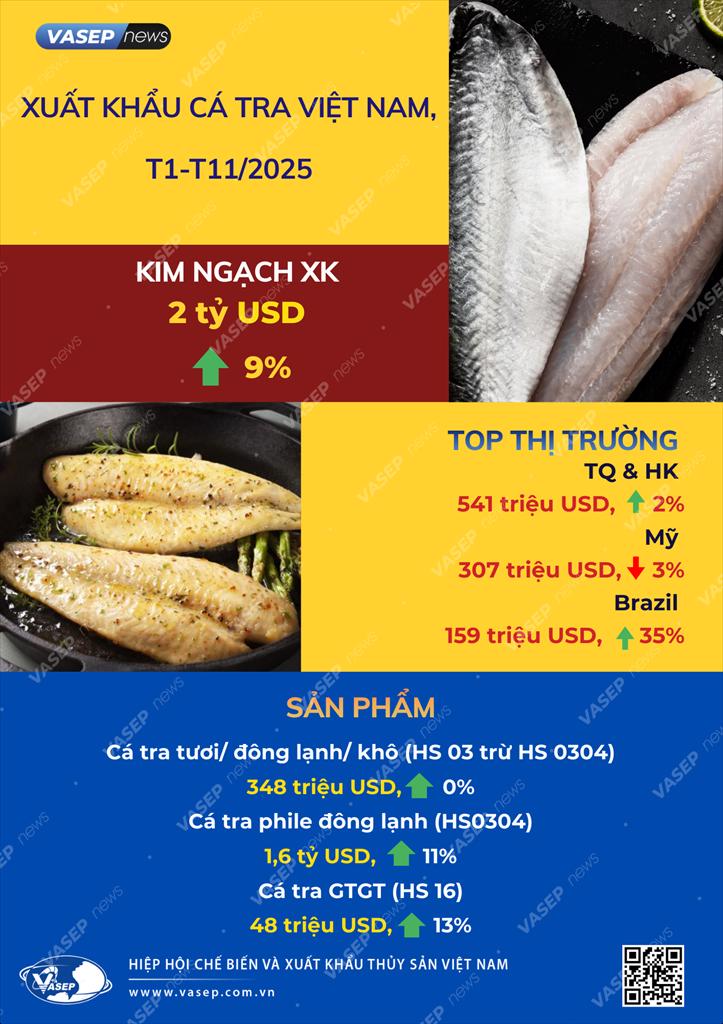
Following strong growth in October, the Chinese market maintained stable momentum in November, with pangasius export value reaching nearly USD 59 million, up 17% year-on-year. China remained the largest contributing market for the month and continued to lead Vietnam’s pangasius export turnover.
In contrast, pangasius exports to the United States fell sharply to USD 20 million, down 23% year-on-year, mainly due to the impact of a 20% reciprocal tariff that has weakened price competitiveness. This downward trend has persisted since August with no signs of recovery in November.
Exports to the European Union (EU) also declined to USD 12 million, down 25% year-on-year, driven primarily by decreases in key markets such as the Netherlands (–18%) and Germany (–20%). Nevertheless, several smaller EU markets recorded slight growth, indicating ongoing intra-EU expansion potential.
CPTPP and Emerging Markets Show Positive Signals
Within CPTPP markets, exports to the United Kingdom reached USD 5 million, down slightly by 4% year-on-year, a smaller decline than in previous months and viewed as an early recovery signal. Mexico remained a bright spot, with exports surging to USD 8 million, up 50%. Japan and Malaysia also maintained stable growth of around 2%, reflecting positive demand trends and further expansion potential.
Exports to Brazil totaled USD 15 million in November, up 13% year-on-year. Over the first eleven months of 2025, cumulative pangasius exports increased significantly to Thailand (+24%), Egypt (+33%), and Russia (+45%). Despite strong growth, these markets still represent a relatively small share of total exports, highlighting opportunities for deeper market penetration.
Product Structure and Outlook Toward 2026
From January to November 2025, pangasius fillet exports under HS code 0304 exceeded USD 1.6 billion, up 11% year-on-year, and continued to dominate Vietnam’s pangasius export structure. Exports of other pangasius products under HS03 (excluding HS0304) reached nearly USD 348 million, remaining stable compared to the previous year, while processed pangasius products under HS16 rose to USD 48 million, up 13%.
Although China continues to show positive growth, declines in the U.S. and EU markets have increased China’s share to around 30% of Vietnam’s total pangasius exports. Looking ahead to 2026, the 20% U.S. reciprocal tariff is expected to remain a major challenge, reinforcing the need for enterprises to diversify export markets, expand value-added and deep-processed products, and strengthen sustainability and international certifications to enhance competitiveness amid intensifying price pressure.